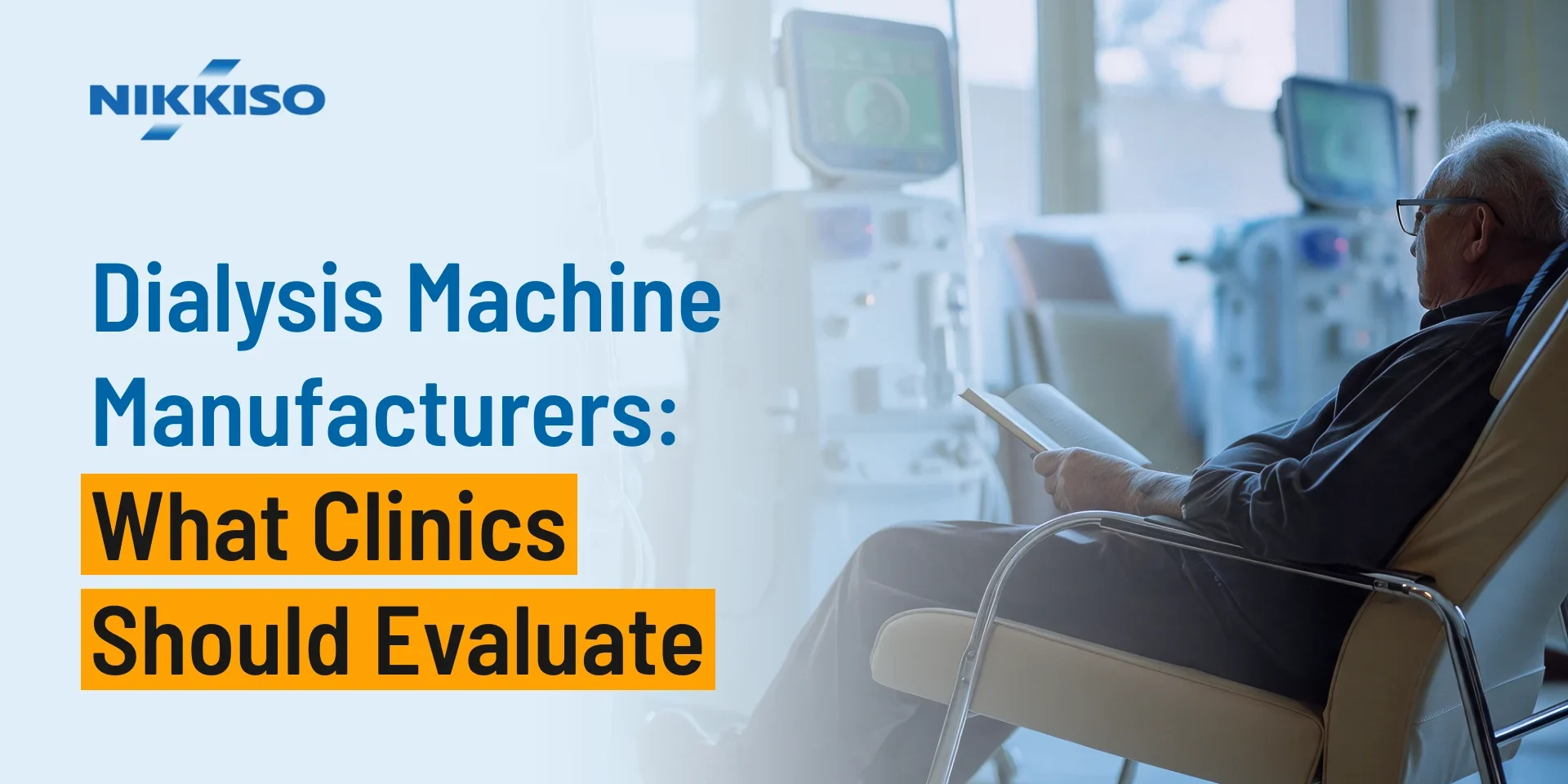

Dialysis Machine Manufacturers: What Clinics Should Evaluate
More than 808,000 people in the United States are living with end-stage kidney disease, and 68% of them receive dialysis, according to the National Institute of Diabetes and Digestive and Kidney Diseases (NIDDK). Most of those treatments are delivered in-center, as only 14% of dialysis patients (as of 2021) perform dialysis at home.
For clinics, this volume turns every hemodialysis machine into a long-term operational commitment. A single unit runs several shifts a day for years, and the manufacturer behind it influences staff workload, survey readiness, supply planning, and the quality of data clinicians use during treatment.
Yet comparing manufacturers is rarely simple. Spec sheets often read alike, and the purchase price leaves out the costs that may surface later in consumables, maintenance, and downtime.
When evaluating dialysis machine manufacturers, clinics should assess seven important areas. The sections below cover each one of them:
Criterion #01: Regulatory Clearance and Compliance Fit
Before comparing features or pricing, clinic leaders should confirm each manufacturer’s regulatory standing. The FDA classifies hemodialysis systems as Class II medical devices under 21 CFR 876.5860, and they require 510(k) premarket clearance before they can be marketed in the United States. Bloodline sets and other accessories are reviewed under separate submissions, so clearance of the machine does not extend to the consumables used with it.
Procurement teams should request the 510(k) numbers for the machine and each associated bloodline, then validate them against the FDA 510(k) Premarket Notification database. This verification creates a documented record of regulatory status before contract negotiations begin.
Regulatory obligations extend well beyond the point of purchase. Under the Centers for Medicare & Medicaid Services (CMS) Conditions for Coverage for ESRD facilities (42 CFR Part 494), clinics must meet AAMI water and dialysate quality standards (§ 494.40) and maintain and operate dialysis equipment in accordance with the manufacturer’s recommendations (§ 494.60). As a result, the manufacturer’s maintenance documentation becomes a direct component of the clinic’s survey readiness.
By way of example, the NIKKISO DBB-06 PRO Hemodialysis Delivery System received FDA 510(k) clearance (K242155) on May 15, 2025, and the Archloop™ Bloodline Set was cleared on the same date under K242176 and K242479.
Criterion #02: Patient-Safety and Monitoring Capabilities
Integrated monitoring gives clinical teams actionable insight while treatment is underway. When comparing dialysis machine manufacturers, a critical distinction is whether these capabilities are built into the platform or delivered through add-on modules and dedicated disposables, which the latter increase both per-treatment cost and setup complexity.
1. Blood Volume Monitoring
Relative blood volume tracking allows clinicians to assess how each patient tolerates fluid removal as treatment progresses. The National Kidney Foundation’s 2015 Kidney Disease Outcomes Quality Initiative (KDOQI) Hemodialysis Adequacy Guideline Update advises prescribing an ultrafiltration rate that balances the risk of hemodynamic instability against the benefit of volume removal. Continuous, in-session data equips clinicians to manage that balance with greater precision.
Ideally, blood volume monitoring is integrated into the machine and does not require additional consumables. Some systems also calculate plasma refilling rate (PRR) from blood volume data, ultrafiltration rate, and pre-dialysis weight, adding further context for clinical decision-making.
2. Real-Time Dialysis Dose Monitoring
KDOQI also recommends a target single-pool Kt/V of 1.4, with a minimum of 1.2 per session, for patients receiving hemodialysis three times weekly. Dose verification commonly relies on periodic blood draws, which provide results only after treatment has concluded.
There are existing systems that measure Kt/V in real time through UV absorbance of spent dialysate, without any calibration or treatment interruption. This provides clinicians with access to dose data while there is still an opportunity to adjust therapy.
3. Ultrafiltration Control and Bloodline Design
Precise fluid removal and early leak detection are fundamental safety requirements. Clinics should confirm that the ultrafiltration control system monitors continuously without interrupting treatment.
Bloodline design also warrants equal scrutiny. NIKKISO’s Archloop™ Bloodline Set eliminates the arterial chamber and minimizes venous chamber volume, reducing more blood-air contact compared with conventional bloodline sets. Integrated diaphragm pressure pods also directly measure venous, arterial, and dialyzer inlet pressures.
Criterion #03: Workflow Automation and Staff Efficiency
Each manual step in priming, blood filling, fluid bolus, and rinse-back consumes clinical time and introduces potential for variation. Across multiple shifts and a full patient census, those steps carry a measurable operational cost.
Dialysis machine manufacturers should be able to demonstrate, step by step, the setup and takedown procedures. They should also be able to document the number of operator interventions required. Automation designed to reduce manual tasks can help standardize routine processes and allow clinical staff to devote more time to patient care.
Staff training is an equally important consideration too. Under 42 CFR 494.140(e), patient care technicians must complete a training program focused on operating kidney dialysis equipment. Therefore, if a clinic has an intuitive system, it can definitely shorten onboarding timelines and promote consistent practice across shifts.
Criterion #04: Consumables, Compatibility, and Supply
Consumables represent a recurring expense across the full service life of the equipment, with direct implications for storage, logistics, and setup time. Clinic leaders should assess the cost per treatment, including whether bloodlines are proprietary to the platform, the storage footprint required by supplies, and the manufacturer’s record of reliable delivery.
Priming volume and packaging density also warrant closer evaluation than they typically receive. Lower priming volumes reduce saline consumption per treatment, while lighter, more compact packaging improves storage efficiency and simplifies handling, transport, and disposal.
Requesting these specifications from each vendor allows procurement teams to compare consumables on the actual operational impact, not unit price alone.
Criterion #05: Service, Maintenance, and Technical Support
Because CMS ties equipment maintenance to the manufacturer’s recommendations, the service program is as much a compliance factor as an operational one. Many have already seen how equipment downtime directly reduces chair availability.
Hence, it is important to evaluate preventive maintenance intervals, parts availability, biomedical technician training, and documented response times. Consider the design for serviceability as well. Quick-access panels and built-in diagnostic checks in service mode can help biomedical teams troubleshoot faster and return machines to the floor sooner.
Emergency readiness belongs in this list too. The CMS emergency preparedness requirements (§ 494.62) include planning for equipment and power failures, so it is necessary that the machine has battery backup that allows rinse-back to be completed during an outage.
Criterion #06: Total Cost of Ownership
The acquisition price, whether purchased or leased, represents only a portion of the total investment. A rigorous total cost of ownership (TCO) model for comparing dialysis machine manufacturers should account for the following:
- Consumable costs per treatment, including any monitoring disposables
- Preventive maintenance, replacement parts, and service agreements
- Initial and ongoing staff training
- Clinical staff time per treatment for setup, monitoring, and takedown
- Equipment downtime and its impact on chair availability and scheduling
These costs should be modeled across the equipment’s expected service life using the clinic’s actual treatment volumes. Capabilities that reduce manual tasks or eliminate add-on disposables may help improve operational efficiency, although the realized impact will vary with each clinic’s workflow, staffing model, and payer mix.
Procurement and finance teams should be aware of the underlying assumptions behind any vendor cost projection and validate them against internal data.
Criterion #07: Manufacturer Track Record and Stability
Selecting a dialysis machine establishes a long-term operating relationship. Clinics rely on the manufacturer for replacement parts, software updates, consumables, and technical support for years after installation.
Due diligence should examine the manufacturer’s tenure in dialysis, the scale of its installed base, the depth of its service and training infrastructure, and its ability to provide clinic references. Named references from comparable facilities carry considerably more weight with clinical and procurement stakeholders than general testimonials.
Leadership teams should also assess the manufacturer’s long-term commitment to the platform under consideration, including its product support timeline and plans for software and hardware updates. This scrutiny helps protect the investment throughout the equipment’s full service life.
NIKKISO, for example, brings more than five decades of experience in dialysis system design and manufacturing. The company developed Japan’s first dialysis system, and has continually served providers in more than 80 countries. In the United States, NIKKISO Medical America specifically supports clinics through a Memphis-based service and training team.
Dialysis Machine Manufacturer Evaluation Checklist
Use this checklist to compare dialysis machine manufacturers side by side during vendor meetings.
| Criterion | What to verify | Key question for the vendor |
|---|---|---|
| Regulatory clearance | What to verify510(k) numbers for the machine and bloodlines | Key question for the vendorCan you provide the K numbers so we can confirm them in the FDA database? |
| Safety and monitoring | What to verifyBuilt-in blood volume, dose, pressure, and UF monitoring | Key question for the vendorWhich monitors are standard, and which require add-ons or disposables? |
| Workflow automation | What to verifyManual steps in priming, blood filling, bolus, and rinse-back | Key question for the vendorHow many operator touches does a full treatment cycle require? |
| Consumables and supply | What to verifyCost per treatment, priming volume, storage, lead times | Key question for the vendorWhat does each treatment cost in consumables, and where do supplies ship from? |
| Service and maintenance | What to verifyPM intervals, response times, biomed training, outage support | Key question for the vendorWhat is your typical response time, and what training do our biomed techs receive? |
| Total cost of ownership | What to verifyLifetime cost, not purchase price | Key question for the vendorCan you share the inputs behind your cost estimates? |
| Track record | What to verifyYears in dialysis, U.S. presence, references | Key question for the vendorCan we speak with U.S. clinics using your equipment? |
Choosing a Manufacturer Built for the Long Term
The right choice among dialysis machine manufacturers comes down to fit: a machine, consumable system, and support model that match your clinic’s workflow, compliance obligations, and patient population over many years of daily use. Clinics that score vendors across all seven criteria are better positioned to avoid surprises after installation.
NIKKISO Medical America combines more than 50 years of Japanese dialysis engineering with U.S.-based service and training. The DBB-06 PRO Hemodialysis System and Archloop™ Bloodline Set were designed to simplify hemodialysis workflows and give clinicians integrated tools to monitor therapy in real time.
Evaluate the technology firsthand. Request a demo with our team, or explore NIKKISO Medical America to learn more about our hemodialysis solutions.
Frequently Asked Questions (FAQs)
- What should clinics look for in dialysis machine manufacturers?
Clinics should evaluate dialysis machine manufacturers on regulatory clearance, built-in safety and monitoring, workflow automation, consumable costs, service and maintenance support, total cost of ownership, and track record. Weighing all seven gives a more accurate picture of long-term value than purchase price alone.
2. How can a clinic verify a dialysis machine’s FDA clearance?
Ask the manufacturer for the 510(k) number, then search it in the FDA’s public 510(k) Premarket Notification database. Check the machine and its bloodline sets separately, since accessories are typically cleared under their own submissions.
3. What does CMS require for dialysis machine maintenance?
Under 42 CFR 494.60, ESRD facilities must maintain and operate dialysis machines and water treatment systems according to the manufacturer’s recommendations. Clinics should keep the manufacturer’s maintenance documentation current and accessible for surveys.
4. What is included in the total cost of ownership for a dialysis machine?
Total cost of ownership includes the purchase or lease price plus consumables, preventive maintenance, parts, service contracts, staff training, staff time per treatment, and downtime. Modeling these over the equipment’s service life gives a more realistic comparison than sticker price. For a detailed breakdown, read our guide on dialysis equipment cost and total cost of ownership.
5. Which monitoring features should a hemodialysis machine include?
Useful features include relative blood volume monitoring, real-time dialysis dose (Kt/V) monitoring, ultrafiltration control, and arterial and venous pressure monitoring. Ask whether each is built in or requires extra modules or disposables.