How Dialyzers Work with a Hemodialysis Machine
Every hemodialysis treatment depends on one component to perform the actual work of filtering blood: the dialyzer.
If one were to ask any biomedical technician or nephrology nurse what makes a hemodialysis machine effective, they will eventually point to the cylindrical filter sitting in line with the bloodline set. While it’s easy to focus on touchscreens, pumps, and monitoring displays, this filtering component is where diffusion and ultrafiltration actually happen.
Understanding how a dialyzer works and how it fits into the rest of the machine provides biomedical and clinical staff with useful context for training and troubleshooting. This article examines its structure, the filtration process it performs, and how its design connects to the surrounding hemodialysis platform.
A dialyzer is the filtering component of a hemodialysis machine, often called an artificial kidney, composed of thousands of hollow-fiber membranes.
Two separate processes occur inside it: diffusion removes waste products such as urea and creatinine, and ultrafiltration removes excess fluid.
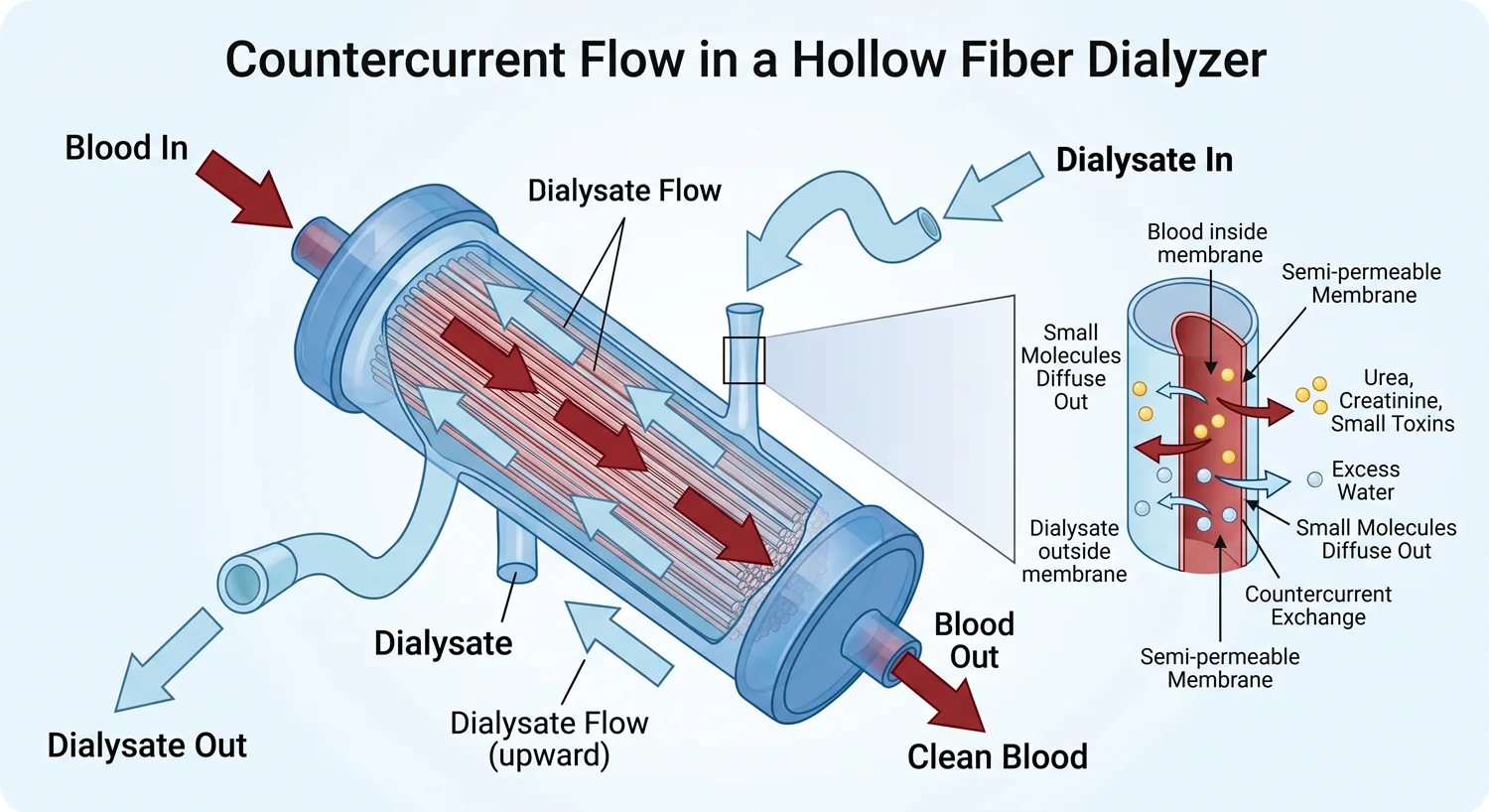
Blood and dialysate flow in opposite directions through it, a design called countercurrent flow, which keeps the concentration gradient strong across the full length of the fiber bundle.
Its membranes are classified as low-flux or high-flux based on pore size, which affects the range of molecules they can clear.
It works as part of a larger system. How well the component performs depends on the bloodline set, dialysate delivery, and the monitoring functions built into the hemodialysis machine.
What Is A Dialyzer?
A dialyzer functions as the artificial kidney at the center of hemodialysis treatment. Most units in current clinical use employ a hollow fiber design, consisting of thousands of thin, semi-permeable membrane fibers bundled within a rigid plastic housing. Each end of the fiber bundle is sealed with a potting compound, which keeps the blood and dialysate compartments separate while still allowing blood to flow through the open core of each fiber. The housing itself has four ports: two for blood entering and exiting the fiber interior, and two for dialysate entering and exiting the space surrounding the fibers.
Blood passes through the interior of these fibers, while dialysate, the fluid responsible for drawing out waste and excess water, circulates around the exterior of the same fibers within the housing. The membrane wall separating the two compartments is porous enough to permit small waste molecules and water to pass through, while retaining blood cells and proteins on the blood side. Packing thousands of narrow fibers into a single housing gives it a large total membrane surface area within a compact, single-use device.
This membrane structure distinguishes this medical device from a simple filter. Its pore configuration, wall thickness, and surface area collectively determine the extent of waste and fluid clearance achievable during a single treatment session. Types also vary in fiber length and bundle density across manufacturers, which is one reason clearance rates can differ between models even when the underlying filtration principle is the same.
The Core Filtration Process
A. Diffusion: Removing Waste Products
Diffusion is the primary mechanism by which a dialyzer clears waste from the blood. Urea, creatinine, and other metabolic byproducts accumulate in the blood between treatments at a higher concentration than in fresh dialysate. Since molecules naturally migrate from an area of higher concentration to lower concentration, these waste products pass through the membrane pores into the dialysate, where they are carried away and discarded. This process is sometimes referred to as solute clearance.
Smaller solutes such as urea diffuse relatively quickly given their molecular size, whereas larger waste molecules move more slowly and clear less completely within a single session, which is one reason membrane characteristics vary by intended use. The dialysate’s chemical composition is calibrated so that necessary substances, such as bicarbonate or specific electrolytes, can move in the opposite direction when replenishment is required. In effect, diffusion simultaneously moves waste out of the blood and needed substances into it, using the same underlying mechanism.
B. Ultrafiltration: Removing Excess Fluid
Ultrafiltration governs fluid removal, a process distinct from diffusion. Between hemodialysis treatments, patients typically retain fluid that the kidneys would otherwise eliminate as urine. Ultrafiltration is the mechanism by which this excess volume is withdrawn during a session. The hemodialysis machine establishes a pressure gradient across the membrane by adjusting pressure on the dialysate side relative to the blood side. This pressure differential drives water out of the blood, through the membrane, and into the dialysate compartment for drainage.
The amount of fluid removed, often referred to as the ultrafiltration volume or ultrafiltration rate, is determined in advance based on the patient’s weight gain since the previous session and other clinical factors. The machine regulates pressure with precision so that the fluid volume removed corresponds exactly to what has been prescribed for that session, neither more nor less.
C. Why Flow Direction Matters
Inside the dialyzer, blood and dialysate typically flow in opposite directions, a configuration known as countercurrent flow. This is distinct from co-current or parallel flow, in which both fluids would move in the same direction, a design used less frequently because it is comparatively less efficient. Research published through the National Center for Biotechnology Information (NCBI) indicates that the countercurrent arrangement sustains the concentration gradient between blood and dialysate across the entire length of the fiber bundle, since the two fluids would naturally equalize under same-direction flow.
Maintaining this gradient throughout the fiber bundle supports more consistent diffusive clearance for a given size and treatment duration. Manufacturers generally recommend a dialysate flow rate higher than the blood flow rate for this reason, since it helps preserve the gradient advantage that countercurrent flow is designed to provide.
How the Dialyzer Fits Into the Hemodialysis Machine
The component sits at the center of the extracorporeal circuit, connected inline with the bloodline set that carries blood out of the patient and back again. During treatment, the blood pump draws blood from the patient through the bloodline set and into the fiber bundle, while a separate delivery system prepares and circulates dialysate on the opposite side of the membrane at a controlled flow rate and temperature. Pressure sensors, flow monitors, and safety alarms integrated into the hemodialysis machine continuously monitor this process, verify that diffusion and ultrafiltration proceed as intended, and alert clinical staff if a parameter falls outside its expected range. In this sense, the dialyzer functions as the fixed point around which the rest of the machine’s systems, pumping, delivery, and monitoring are built.
The type of unit selected also influences how this process performs. Low-flux membranes have smaller pores and are designed primarily to clear small solutes such as urea and creatinine. High-flux membranes have larger pores and greater water permeability, enabling them to clear a broader range of solute sizes, though they typically require more precise ultrafiltration control from the machine. Neither membrane type is universally superior. The appropriate choice depends on the treatment plan, the patient’s clinical needs, and the platform on which the device is used.
Bringing It Together
A dialyzer’s function is basically to filter the blood and remove what the body no longer needs. Achieving that requires a precise interaction between membrane structure, pressure control, and flow direction, all coordinated by the hemodialysis machine to which it is connected.
Nikkiso Medical America’s DBB-06 PRO Hemodialysis System is designed to support this process through automated monitoring, including Blood Volume Monitoring and Dialysis Dose Monitor, which provide clinicians with additional real-time treatment information during diffusion and ultrafiltration. Paired with the Archloop™ Bloodline Set, which is designed to reduce blood-air contact during treatment, the system is built to work in conjunction with the dialyzer.
To learn how the DBB-06 PRO fits into your clinic’s hemodialysis workflow, visit Nikkiso Medical America or request a demo with our team.
Frequently Asked Questions (FAQs)
1. What is the difference between diffusion and ultrafiltration in a dialyzer?
Diffusion removes waste products like urea and creatinine by moving them from an area of higher concentration in the blood to a lower concentration in the dialysate. Ultrafiltration removes excess fluid using a pressure gradient across the membrane. They happen simultaneously but through different mechanisms.
2. What is a hollow fiber dialyzer made of?
It consists of thousands of thin, semi-permeable membrane fibers bundled inside a rigid plastic housing, with each end of the bundle sealed by a potting compound that keeps the blood and dialysate compartments separate.
3. Why does dialysate flow in the opposite direction of blood in a dialyzer?
This countercurrent flow keeps the concentration gradient between blood and dialysate strong across the entire fiber bundle, which supports more consistent waste clearance than if both fluids flowed in the same direction.
4. What is the difference between a low-flux and high-flux dialyzer?
Low-flux membranes have smaller pores and are built mainly to clear small solutes like urea and creatinine. High-flux membranes have larger pores and greater water permeability, allowing them to clear a broader range of solute sizes.
5. Is a dialyzer reused or single-use?
Dialyzers are most commonly single-use devices, though reuse protocols exist in some clinical settings. The choice depends on clinic policy and the treatment plan, not on a fixed rule.